
Why Keep Sowing Seeds?


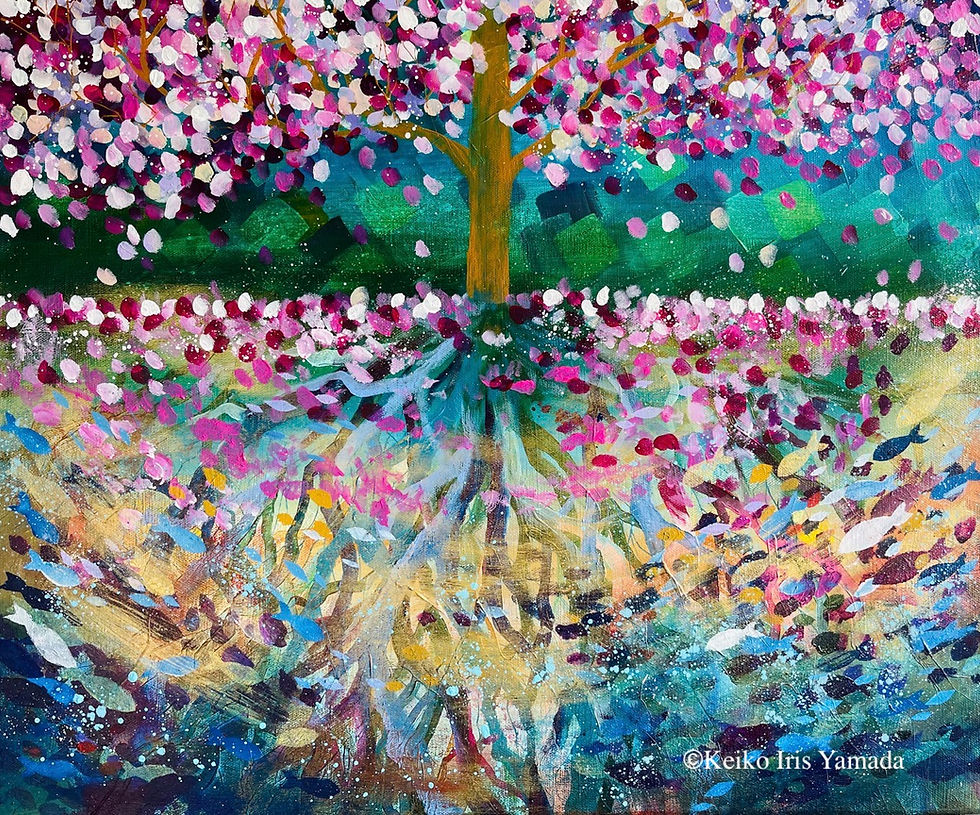
A Hymn of Joy ~ 喜びの讃歌
Inspired by Psalm 126:5Keiko Iris Yamada
Acrylic on Canvas
15 x 18 inch
When I was a student, I lived in a house owned by a woman named Helen. She had what people call a “green thumb.” Somehow, the tomatoes she casually tossed into her garden would grow into healthy plants a few months later, producing plenty of tomatoes. I, on the other hand, am the kind of person who can work hard to grow basil, only to watch it wilt and die before long.
Most of us sow seeds with the hope of seeing certain flowers bloom or tasting the fruit we have imagined. But what grows does not always turn out the way we expect. Even when we do our very best, our plants may be eaten by insects or wither because of bad weather. There are so many factors beyond our control. Yet if we give up sowing seeds altogether, it is clear that nothing will grow.
This painting was born out of a season in my own life when I was reflecting on these very things. During that time, the following words from the Bible spoke to my heart in a particularly powerful way:
Those who sow with tears will reap with shouts of joy.
Psalm 126:5
🌿🌿
Psalm 126
Psalm 126 is one of the “Songs of Ascents,” sung by people making their way up to Jerusalem to worship God.
In verses 1–3, the first half of the psalm, the people remember the great things God had done for them in the past, and their hearts overflow with joy.
In verses 4–6, the second half, they find themselves in a world where there are still circumstances that bring tears rather than joy. In the midst of that reality, they pray to the same God who had done great things for them before. Their prayer is essentially this: “Lord, do great things for us again, just as You did in the past.”
They pray to the One who not only understands each of our tears but is also able to turn those tears into joy.
When Our Dead Ends Become Seeds
Perhaps there are times when we, too, feel as though we are caught between verses 1–3 and verses 4–6 of Psalm 126.
We vividly remember how God truly did amazing things in the past! Yet at the same time, we find ourselves facing present realities that make us wonder, “Where is God in all of this?”
Even if we do not believe in the God of the Bible, we may still have experienced good things in the past. There may be much for which we are grateful.
And yet, we may now be facing difficulties.
The joys of the past do not make our present suffering disappear. Perhaps some of you find yourselves in exactly that kind of situation.
When I painted this piece, A Hymn of Joy, I was also looking back on the past, remembering how God had brought seeds I had sown to life and given me things I had long hoped for. At the same time, I was facing challenges as I sowed new seeds in United States, the place where I was beginning a new chapter of my life.
“You gave me the art studio I had prayed for! You gave me the visa I needed to go to America! Thank You, God!”
While I was grateful for these things, life in United States was not unfolding the way I had imagined, and I was beginning to feel stuck.
In times like these, when our struggles feel overwhelming, we may find ourselves longing for a mighty wave, like the rushing waters depicted in this painting, to sweep in and change our circumstances in an instant. We look to something greater and more powerful than ourselves, hoping for a dramatic change.
The Streams of the Negev

The river-like flow depicted in this painting represents the “streams of the Negev.”
You may not be familiar with this name, but the Negev is a region in what is now southern Israel. It appears in the verse immediately preceding the verse that inspired this painting.
“Restore our fortunes, LORD, like streams in the Negev.”
— Psalm 126:4 (NIV)
Although the psalm speaks of the streams of the Negev, the region is dry for much of the year, with riverbeds that remain empty. But when rain occasionally falls, water rushes in all at once, filling the parched land.
In other words, this prayer expresses a longing for God to pour water into our utterly dry circumstances, like the streams of the Negev, and restore us from the difficult situations we are facing.
The verses that follow this prayer, verses 5 and 6, express a powerful trust in God. To me, they sound less like a request and more like a declaration: “And so, God, I will keep sowing seeds with You.”
“Those who sow with tears will reap with shouts of joy.
Those who go out weeping, carrying seed to sow, will return with songs of joy, carrying sheaves with them.”
— Psalm 126:5–6 (NIV)
Notice that the psalmist does not say, “Please let me reap with joy!” Instead, the words boldly declare, “They will reap with shouts of joy!”
How could the person who wrote this psalm make such a bold declaration?
🌿🌿
The Secret to Continuing to Sow Seeds
Perhaps it was because the psalmist was convinced of who God is and had learned to trust Him.
When we cannot see the results, we keep praying to God as we continue to sow seeds.
Through those prayers, we come to know more deeply just how faithful God is. In the process, we ourselves are changed. Sometimes, even our expectations of what we hope to harvest from the seeds we have sown begin to change.
And as the time of fulfillment gradually approaches, our confidence grows that, in His time, God will surely enable us to reap with joy.
Throughout the Bible, we find countless reminders that God is faithful. Even today, many Christians continue to experience His faithfulness and share their testimonies of it.
To say that “God is faithful” means that He does not forget His promises but brings them to fulfillment. Even when we cannot see the results right away, He continues to work patiently and unchangingly. He is also a God who delights in the harvest.
As we come to know His faithfulness more deeply, our conviction grows that He is worthy of our trust. We, too, can begin to make declarations like the one in Psalm 126:5, and that confidence becomes a source of strength as we walk through each day.
As we come to know God personally, we may also become more painfully aware of our own unfaithfulness. Perhaps that, too, is a natural part of the journey.
A God who never deceives, and me, who sometimes do.
A God overflowing with love, and me, who so often fall short of love.
.... and so on.
And yet, for people like us, Christ gave His own life on the cross, paying the price for us.
Perhaps one of the things we can reap as we continue to sow seeds is a deeper understanding of Christ’s love than we have ever known before.
And the more deeply we come to know that love, the more wholeheartedly we will praise this God.
For Christ Himself is the “water of the streams of the Negev” that God has already given us.

A Hymn of Joy
Even if you have never been to church, you may picture people singing hymns or praise songs when you think of a church service.
There are many different styles of hymns or praise songs. Some are sung with exuberant energy, like gospel music, while others are accompanied by the powerful sound of an organ. The styles vary from church to church, but they share something in common: they sing about who God is and how wonderful He is.
When we are grieving, when we face difficult circumstances, and when we struggle because we keep sowing seeds but cannot yet reap a harvest, the church still invites us to join our voices together and sing praises to God.
Is it because we are trying to escape the painful realities of life?
No.
It is because we do not want to forget who God is, even in the midst of those painful realities. Remembering who God is becomes a source of hope and gives us strength to keep walking through each day.
In A Hymn of Joy, I painted the leaves of Gingko Trees, using vivid shades of orange and red to evoke the autumn harvest.
When I painted this piece, I had temporarily returned to my family home in Japan from United States. As it happened, I had only a very limited selection of acrylic paint colors available to me. In a way, that limitation seemed to reflect the circumstances of my life at the time, when I was feeling stuck.
Even so, I kept painting while listening to hymns such as “Great Is Thy Faithfulness,” reminding myself that God is faithful. And because I had only a limited range of colors to work with, my imagination was stimulated in unexpected ways. In that sense, this painting itself was born, at least in part, out of those limitations.
Perhaps the “colors” we have available to us right now are limited, too.
Perhaps our circumstances do not allow us to paint the picture we had envisioned.
Even so, it is precisely in such times that something new can emerge as we turn our eyes toward God's faithfulness. Seeds sown in those circumstances may bear fruit we never expected, bringing us joy.
I hope you will take a moment to imagine what that might look like in your own life.
The piece of music I am sharing with you today is an arrangement of “Great Is Thy Faithfulness.” Toward the end, the music transitions into the familiar melody of “Ode to Joy,” the theme from the fourth movement of Beethoven’s Ninth Symphony, a piece that symbolizes joy and celebration.
As you listen, why not take a moment to reflect on these questions?
When you cannot see the results, what are you placing your trust in? And why do you keep sowing seeds?
And perhaps you might take those thoughts and turn them into a prayer to God, using your own words.
🌱🌱🌱
Thanks for reading. God bless you!


Comments